Overview

Focusing on the more traditional and local side of these destinations, this itinerary is perfect for those wanting to completely immersive themselves into timeless traditions and uncover hidden gems that only the locals know about.
From staying in a monastery guest house, to hiking through remote chilli fields to reach lesser-known temples. Be dragged by your feet by a monk through a small opening into a hidden rock monastery and sip tea with Tibetan nuns. read more This journey is truly for those travellers who seek something more rewarding in discovering the lesser known on their travels.


Active

4 - 4.5 Star

Premium

18-99 Years

12

Moderate

Fully Guided, Locally Guided

CCBNT
Itinerary
Welcome to Bhutan! The flight into Paro is one of the most spectacular in the entire Himalayas. Flying along the Himalayan ranges, the journey offers fascinating views and an exciting descent into the Kingdom. Bhutan's first gift to you as you disembark from the aircraft will be cool, clean fresh mountain air. After immigration formalities and baggage collection, you will be met by our representative, and afterwards drive to Thimphu, the capital town of Bhutan.
On arrival, in Thimphu check-in to your hotel. The capital town of Bhutan and the centre of government, religion and commerce, Thimphu is a unique city with unusual mixture of modern development alongside ancient traditions. With the population of about 90,000 it is perhaps still the world's only capital city without a traffic light.
As evening falls and dinner approaches, you'll have the opportunity to meet one of Bhutan's most esteemed scholars. This expert will guide you through an enlightening lecture on Gross National Happiness (GNH) and offer a captivating introduction to Bhutan and its people. Discover the unique principles that shape Bhutan's approach to well-being and gain deeper insights into the rich cultural tapestry of this Himalayan kingdom.
Enjoy an evening exploratory walk around Thimphu main street and market area.
After breakfast, depart for a guided tour of the city's main attractions starting with the Textile Museum where you will get to know the living national art of weaving. Exhibitions introduce the major weaving techniques, styles of local dress and textiles made by women and men. Your next stop is the National Library, home to thousands of ancient manuscripts and texts, alongside modern academic books and traditional printing blocks for prayer flags. Within its walls, the rich history of Bhutan is carefully preserved, etched into the pages of its archaic writings.
Continue to the Institute for Zorig Chusum, commonly known as Arts & Crafts School or Painting School. The Institute offers a six-year course on the 13 traditional arts and crafts of Bhutan and on your visit, you can see students learning the various skills taught at the school. Zorig Chusum is an art school and is periodically closed for exams, summer and winter holidays, however if closed we will replace the visit to the Buddhist temple Zangthopelri Lhakhang.
This temple present structure was built in 1960s and although lacking the charm of many of the older temples, it still possesses some impressive murals and art treasures and is worthy of a visit. The site of the temple was a former battle ground, and the temple was constructed there to pacify energies.
Next you will visit the Simply Bhutan Museum. This newly commissioned museum depicts the ancient Bhutanese architecture which is being lost to modernisation. The uniqueness of the structure is in its composition of the materials used. The structure is built reusing old timber, window and door frames and other items from traditional and old demolished houses. The best part is the portrayal of the age-old lifestyles of the Bhutanese people.
Enjoy lunch before visiting the Memorial Chorten. This stupa was built in the memory of Bhutan's third King, His Late Majesty, King Jigme Dorji Wangchuk, who is popularly regarded as Father of modern Bhutan. The paintings and statues inside the monument provide a deep insight into Buddhist philosophy.
Continue to visit Buddha Point (Kuensel Phodrang) which is located a short drive from Thimphu city centre, and providing a good overview of the Thimphu valley from the Buddha point (Kuensel Phodrang). You can pay your obeisance and offer prayers to the Buddha, the largest statue in the country and then walk around for panoramic views of the valley below. Here at the Buddha point, you will have the opportunity to meditate in a designated room, followed by coffee/tea admiring the grand bird eye view of Thimphu valley and beyond.
Your last visit of the day is a visit of Trashichhoedzong, “fortress of the glorious religion”. This is the centre of government and religion, site of monarch's throne room and seat of Je Khenpo or Chief Abbot. Built in 1641 by the political and religious unifier of Bhutan, Shabdrung Ngawang Namgyal, it was reconstructed in 1960s in traditional Bhutanese manner, without nails or architectural plans.
Depart Thimphu this morning for the 3-hour drive to Punakha, Bhutan's former capital. En route, ascend to the Dochu La pass at 3,050 metres. Weather permitting, enjoy sweeping views across the Eastern Himalaya, often framed by colourful prayer flags fluttering in the wind. Pause here for a warming drink and a chance to take in the crisp mountain air.
Continue through traditional countryside to the village of Thinleygang, where you'll stop for lunch at Aum Toeb Zam homestay. Gain insight into rural Bhutanese life and culinary heritage, with a hands-on introduction to traditional cooking techniques and ingredients. Engage in customary village pastimes such as archery, khuru (darts), or degor, offering a deeper connection to Bhutan's enduring sporting culture.
As the road descends towards Punakha, the scenery shifts dramatically. Dense alpine forest gives way to subtropical greenery as you reach the fertile valley at 1,250 metres. En route, stop at Chimi Lhakhang—commonly referred to as the Temple of Fertility—built in the 15th century by the eccentric Buddhist saint Lama Drukpa Kuenley. Set amidst terraced rice fields, the temple remains a place of pilgrimage for couples seeking blessings for fertility.
Later, take a stroll through Khuruthang town and explore the Kaja Throm market area, offering a relaxed introduction to life in this picturesque valley.
This morning, set out on foot for Khamsum Yuelley Namgyel Chorten, a striking hilltop temple built to honour Bhutan's fifth king. The hike begins from a suspension bridge spanning the Mo Chhu River, leading you through the rice terraces of Yebisa village. The first 10 minutes are flat, followed by a steady 40–50-minute ascent. While mostly gentle, a few steeper sections require moderate effort. At the summit, the 30-metre-high chorten offers commanding views over the Punakha Valley and its traditional villages. After descending back to the river crossing—around 30 minutes on foot—your driver will be waiting to continue the day.
Next, explore Punakha Dzong, known as the “Palace of Great Happiness.” Constructed in 1637, this fortress-monastery stands at the confluence of the Po Chu and Mo Chu rivers and played a central role in Bhutan's early unification. Its intricate woodwork and towering whitewashed walls remain among the country's finest examples of dzong architecture.
In the afternoon, drive to Sangchhen Dorji Lhuendrup Nunnery, set on a ridge with panoramic views of the valleys below. The temple is home to one of Bhutan's largest bronze statues of Avalokiteshvara, the bodhisattva of compassion, crafted entirely by local artisans. The complex also serves as a centre for higher education and vocational training for nuns.
Time permitting, visit the Nalanda Buddhist Institute, home to around 180 monks. Here, traditional Buddhist teachings are complemented by modern subjects such as English and science, reflecting Bhutan's evolving approach to education within monastic life.
After breakfast, drive back to Paro descending back down from the Dochula Pass, following the way back up the dramatic Wang Chhu and Paro Chhu River valleys, before crossing through Paro Town towards the north end of the valley. Enroute, visit Simtokha Dzong, the place of profound tantric teaching that now houses a school for the study of the Dzongkha language.
Later in the day after checking into your hotel, visit Ta Dzong, originally built as Watchtower, which now houses the National Museum. The extensive collection includes antique thangkha paintings, textiles, weapons & armour, household objects and a rich assortment of natural and historic artefacts.
Your Ta Dzong visit is followed by a short walk down the trail to visit Rinpung Dzong, meaning (“fortress of the heap of jewels”), which has a long and fascinating history. Along the wooden galleries lining the inner courtyard are fine wall paintings illustrating Buddhist lore such as four friends, the old man of long life, the wheel of life, scenes from the life of Milarepa, Mount. Sumeru and other cosmic Mandala. You will also have the chance to visit a traditional farmhouse.
As the evening unfolds, immerse yourself in Bhutanese culture by donning the traditional national dress—the Gho for men and Kira for women. Next, enjoy a mesmerizing Mask Dance and Cultural Show, where vibrant costumes and rhythmicmovements bring Bhutan's rich traditions to life.
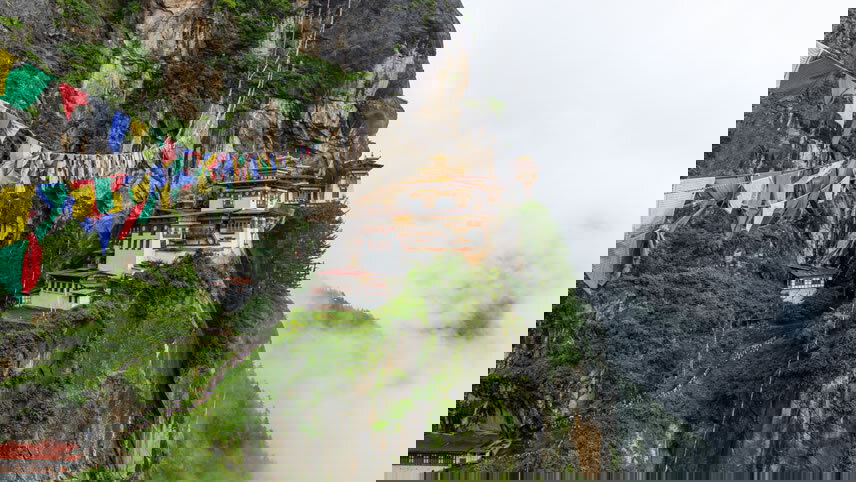
After breakfast, set out for the iconic hike to Taktshang Monastery—commonly known as Tiger's Nest. This sacred site is one of Bhutan's most renowned and revered monasteries, dramatically perched on a cliffside 900 metres above the Paro Valley floor. Begin with a 20–45 minute drive from your accommodation to the car park at the base of the trail.
From here, follow a well-worn path through pine forest to the cafeteria viewpoint, a 1.5 to 2-hour hike offering your first clear view of the monastery. Tea is available here for those wishing to pause before the next ascent. Those continuing to the monastery itself will take a further 1.5 to 2 hours, traversing a series of stone steps that lead into a forested gorge before climbing up to the entrance. The trail is steep in parts but well-maintained.
According to legend, Guru Rinpoche flew to this spot on the back of a tigress and meditated in a cave now enshrined within the monastery. This site has held deep spiritual significance since the 8th century and was later visited by Shabdrung Ngawang Namgyal in 1646. It remains a pilgrimage site visited by all Bhutanese at least once in their lifetime. A fire in April 1998 destroyed significant parts of the monastery, but it has since been carefully restored to its former splendour.
After visiting the temple complex, descend to the base (2 to 3 hours). Lunch will be arranged in Paro town or at the trailhead cafeteria, depending on timing and group pace.
Time permitting, visit Kyichu Lhakhang, a 7th-century temple built by Tibetan King Songtsen Gampo. This is one of the oldest and most sacred temples in Bhutan, marking the advent of Buddhism in the region.
This evening, enjoy a traditional home-cooked dinner at a local farmhouse. Afterwards, you may choose to relax with a hot stone bath—an ancient Bhutanese practice said to relieve fatigue and revitalise the body after a long hike.
After breakfast at your hotel, drive to the airport for your flight to Kathmandu (1hr 20min). Upon arrival at Kathmandu's International Airport, you will be met and transferred to your hotel in Patan.
Nepal – officially the Federal Democratic Republic of Nepal is a mystical country nestled in the folds of the magnificent Himalayan mountain ranges. The people of Nepal can always be seen to be smiling. Nepal is a deeply religious country, as you will see in their temples, monasteries and buildings. The fertile, mountain-sheltered Kathmandu Valley is the historic heart of Nepal, where the Himalaya's most sophisticated kingdoms rose and fell and where Nepali art and culture were developed and refined. In many ways the Kathmandu Valley is Nepal.
The rest of the day is free for you to enjoy at leisure.
After breakfast, it's time to explore Kathmandu City and the historic Durbar Square. Kathmandu, also known as Kantipur, is the vibrant capital of the Kingdom of Nepal. Here you will visit the temple of the Living Goddess who acknowledges the greetings of the devotees from the balcony of her temple residence. Kashtamandap, the namesake of Kathmandu, is supposed to have been built from the timber of a single tree, and stands within Durbar Square.
This afternoon, visit Bhaktapur Durbar Square. Bhaktapur City (Bhadgaon) is also known as the city of devotees and is the home of medieval art and architecture. Lying 14 kms east of Kathmandu City, the city was founded in the 9th Century is shaped like a conch shell and at a height of 4600 ft. above sea level.
Explore Durbar Square whose array of temples is overlooked by a Palace of 55 windows built by King Bupatindra Malla. The Nyatapola Temple, also built by King Bhupatindra Malla, is the best example of Pagoda style and stands on five terraces on each of which stands a pair of figures – two famous strong men, two elephants, two lions, two griffins and two goddesses.
After breakfast, visit the quaint and ancient villages of Bungmati and Khokana. Within the Kathmandu Valley lays Bungmati, a small Newari village still abiding its tradition. Little influenced by the modern world, Bungmati exemplifies true beauty of the still living age old culture and civilisation.
Your journey to Bungmati starts with a vantage point where one can behold the entire village of Bungmati and Khokana. Walking down the lanes of Bungmati, you will pass through local Newari people busy working on intricate designs in wood or stone on their way to creating many more beautiful artefacts keeping their talents running for the future generations to enjoy. Though small in size, at least 100 people from the village earn their living through wood carving. The village is the origin of the procession of the chariot of Machhindranath, one of the most important festivals of the Newari community.
Not far from the village of Bungmati is another interesting Newari village called Khokana, where an important temple of Lord Ganesha is situated. Khokana is also a small Newari village established in the 7th century AD by the mighty Licchhavi rulers of Nepal. It is a unique village because of its detachment from modern civilisation.
Later in the afternoon, drive to Pherping, Neydo Monastery. Spend the night amidst the most scenic area in the Kathmandu Valley, in a Buddhist Monastery Guesthouse, located in the most peaceful location alongside Neydo Tashi Choeling Monastery. Here you will learn about the life of a monk.
At 5pm, witness the debating session of the monks, which happens outdoors, behind the monastery. It's an interesting activity to watch, looking almost like a great challenge with an opponent, with the purpose of helping monks to understand and internalise the teachings of the day.
Following the debating, experience the daily protection puja, with the constant beating of drums, blowing of the conch shell and long traditional horns etc. This traditional ritual is dedicated primarily to Mahakala and his retinue, along with other Dharmapalas, the Protectors of the Buddha Dharma. It seeks to safeguard the Dharma, preserve its lineage, and offer protection to all true practitioners of the path. Dinner is from 7pm in the dining room.
After breakfast, set off for Bhaktapur, also known as Bhadgaon, or the ‘City of Devotees'. The smallest of the three cities in the Kathmandu Valley, Bhaktapur is a masterpiece of medieval architecture and Newari culture. The main square, known as ‘Layaku', is home to some of the valley's most striking landmarks, including the 15th-century Palace of 55 Carved Windows and the intricately adorned Golden Gate, once used as the royal entrance.
Scattered across the square are architectural gems like the Lion Gate, the stone temple of Vatsala Devi, and a striking statue of King Bhupatindra Malla perched atop a monumental pillar. Nearby, you'll find the famous ‘Bell of Barking Dogs', a bronze bell commissioned by King Ranjit Malla in 1737.
Following your exploration, continue on to the peaceful village of Panauti, where you'll enjoy lunch and settle in for an overnight stay at a local community homestay.
Often described as a hidden gem, Panauti sits at the confluence of the sacred Rosi and Punyamati rivers and holds a special place in Nepalese history. Gifted in the 18th century as a dowry by the king of Bhaktapur, the town still resonates with timeless beauty, temples, festivals, and artisanal traditions that remain vibrantly intact.
Your accommodation here is part of a women-led homestay network guided by the philosophy: ‘Run by the Women, for the Women'. It's a meaningful way to experience the daily rhythms of Nepali village life while directly supporting local female entrepreneurs. Meals are lovingly prepared by your host family, and if you're curious, you're warmly invited into the kitchen to take part in the cooking process.
After breakfast, depart for Namobuddha, one of the most sacred Buddhist pilgrimage sites in Nepal. Steeped in legend, this hilltop monastery is said to be the place where a young prince, (an incarnation of the Buddha), offered his body to a starving tigress and her cubs, an act of profound compassion that continues to inspire pilgrims and spiritual seekers.
From Namobuddha, your journey continues to Dhulikhel View Tower, where panoramic views stretch across the Himalayas. After taking in the mountain air, you'll be transferred back to Kathmandu for the evening.
After breakfast you will be transferred to the airport in time for your next flight to Lhasa. Enjoy your trans-Himalayan flight (1hr 20m), considered to be one of the most beautiful air routes in the world. It takes you over Everest (8,848m), Kanchenjunga (8,536m) and other Himalayan peaks and glaciers.
Upon your arrival in Lhasa, a representative from our office will pick you up from the airport and drive you to your hotel in Tsedang. The altitude in Tsedang is about 3,550m/11,646ft above sea level so we suggest you take plenty of rest for proper acclimatisation for the next day's activities. We recommend that for the next few days in Tibet you avoid strenuous activity, and that you don't take a shower on the first day.
For first time visitors, it is common to have different degrees of high-altitude sickness symptoms. Drink lots of water, eat fresh fruit and plenty of rest which will help to prevent the sickness.
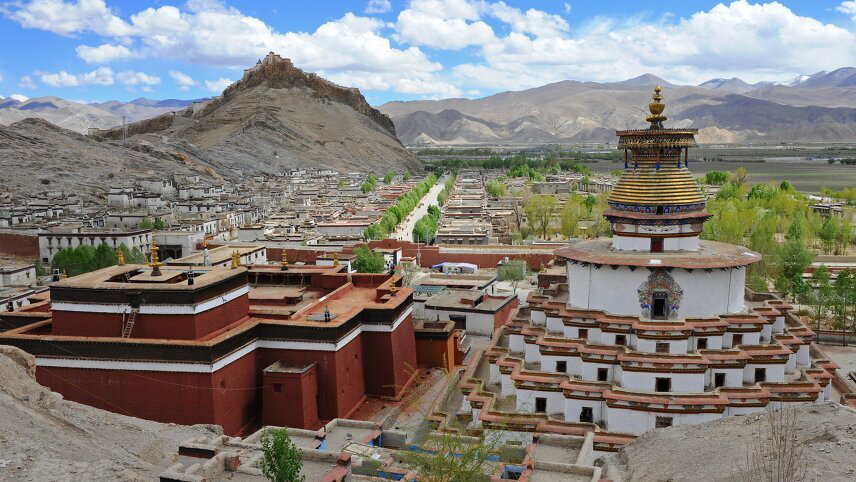
This morning after breakfast, depart for a day excursion to Drak Yangzom & Dzong Kumbum. The cave complex of Drak Yangdzom has long been a favourite among the traveller because there's just nothing else like it in Tibet. Getting into the caves involves climbing a wood and yak hide ladder high up into the mouth of a cliff and then hauling yourself up a narrow, slippery shute into a sacred cave complex before a nun finally drags you by the feet through a tiny opening in the rock wall into the inner sanctum, the sacred cave of a Himalayan saint. It's the craziest excursion in Tibet.
On the other side of the valley is Dzong Kumbum, a less narrow but much longer cave complex of several branches. You will be joined a group of Tibetan pilgrims for a tour of the sacred marks, stalactites and pools.
Visit Samye Monastery, laid out in the shape of a giant mandala, and with the main temple representing the legendary Mount Meru in the centre. Other buildings stand at the corners and cardinal points of the main temple, representing continents and other features of tantric Buddhist cosmology. The main temple is full of Tibetan religious art in mural and statue forms, as well as some important relics. Many Tibetan Buddhists come on pilgrimage to Samye, some taking weeks to make the journey.
This afternoon, explore the local town and take a short walk to Hipuri Hill. From the Hipuri Hill you have a beautiful view of the Samye monastery.
After breakfast, continue your scenic road trip to one of Tibet's most incredible landscapes – Yamdrok Lake. Surrounding snow-capped mountains, the lake is one of Tibet's four holy lakes, and it's believed to be the lifeblood of the country. Yamdrok Lake or Yamdrok Tso is also known as the Scorpion Lake for its unique shape.
Yamdrok Tso covers a staggering 230 square miles and lies at nearly 15,000 feet above sea level. Rife with aquatic life, dotted with islets, and surrounded by fields of wildflowers, Yamdrok Tso is not only naturally stunning but an important place of pilgrimage; its waters are believed to hold powers of rejuvenation and longevity, and to bless children with intelligence.
Its small islands are home to roosting birds and, during the herding season, to flocks of sheep, ferried there by herders who leave them in peace and safety until the onset of winter. Pilgrims often wander the lake's shores, making their way along kora paths, many of which take a week to complete.
Continue to Ani Sangkhung Nunnery, a convent where the females study Buddhism and with a history that can be traced back to 7th century. Ani Sangkhung emphasise the beliefs of Guanyin Bodhisattva – the Goddess of Mercy. Hundreds of flowers surround the house and there is a tea house located in the yard. It is a lovely place to stop for a cup of tea.
After breakfast, drive to Lhasa. Lhasa is rightly one of the most featured and dreamt-about cities in the world. This is not only due to its remoteness and high altitude—3,650 meters above sea level, which limits accessibility—but also because of its remarkable heritage, spanning over a thousand years of cultural and spiritual history. This legacy has shaped the romantic and mysterious Tibetan religion.
Unlike the inland cities and other regions of Tibet, Lhasa stands apart with its unique charm and allure. In Tibetan, Lhasa translates to “Holy Land” or “Buddha Land.” It serves as the political, economic, and cultural center of Tibet. The majestic Potala Palace in Lhasa remains a world-renowned symbol of the profound interplay between politics and religion in this enigmatic region.
Later, visit Ani Tsankhung Monastery, built in the 7th century by Songsten Gampo who used it as a meditation chamber. The monastery is a yellow building which lies on the street parallel and north of Chingdol Dong Lu. Since the 12th century the monastery has been used chiefly by Buddhist nuns and the nunnery's main hall contains a beautiful image of Chenrezi, the multi-armed bodhisattva of Compassion. The sacred meditation chamber lies behind it. An air of quiet serenity pervades the ancient place with its flower bushes and spotless compound and is one of the quieter tourist locations in the Tibetan capital.
Enjoy a final breakfast in Lhasa before transferring to the airport for your onward journey.
Trip Inclusions
- Lecture on Gross National Happiness in Thimphu by a leading Bhutanese scholar
- Meditate in a designated room at Buddha Point, overlooking Thimphu Valley
- Enjoy tea with panoramic views from Buddha Point
- Attend a traditional mask dance and cultural show in Paro
- Visit a Bhutanese farmhouse for a home-cooked dinner followed by an optional hot stone bath
- Spend the night in a working monastery with monks at Neydo Monastery, Nepal
- Enter the Drak Yangdzom cave in Tibet, where a nun pulls you into the sacred chamber by your feet
- Visit Yamdrok Tso, one of Tibet's holiest lakes, surrounded by snow-capped peaks and wildflower fields
- Return airport transfers
- All 15 nights' accommodation
- Meals as per the itinerary
- Private English-speaking local guides in each region
- All transfers mentioned in the program with private air-conditioned vehicle
- Entrance fee for all sights mentioned in the program
- Govt. royalty and taxes
- Bhutan Visa fee
- Tibet Travel permits
- Flights - Paro to Kathmandu/Kathmandu to Lhasa
- International and domestic flights (supplement quoted above)
- Visas (excl Bhutan)
- Travel and medical insurance
- All services, meals other than those indicated above
- Any changes to the proposed and confirmed program.
- All items of a personal nature e.g. drinks, laundry, telephone calls, tips etc
- Early check-in/Late check-out
- Accommodation, itinerary and inclusions subject to change.
- Disruptions to itinerary may occur.
Operator
Known for our in-depth more knowledge of our destinations we distinguish ourselves by offering exceptional, off-the-beaten-path experiences, intimate group sizes (max 12), personalised service, and a deep commitment to creating extraordinary memories. If you're an adventurous but polished traveller seeking unique and transformative experiences, Crooked Compass is for you.
Prices & Dates
There are currently no departures available on this trip. Either it's the end of the season and new departures will be released shortly, or this itinerary has been changed and is not operating this season. Feel free to contact us for information about when next seasons dates will be released or click here to view general release dates for all destinations.
Tour & cruises prices are per person. Prices shown have savings applied, are subject to availability and may be withdrawn at any time without notice. Pricing and trip details are correct at this point in time, however are subject to confirmation at the time of booking and are subject to change by Crooked Compass. For cruise itineraries, cabin images are sourced from the cruise-line and should be treated as indicative only. Cabin inclusions, upholsteries and room layout may differ to the image(s) shown depending on the ship selected and your sailing dates.
Similar Tours
16 Days Luang Prabang Siem Reap
Operated By: Crooked Compass
15 Days Tashkent Dushanbe
Operated By: Crooked Compass

