Following Marco Polo

Overview

Merchant caravans carrying silk, gold, ivory, exotic animals, plants and other precious commodities used to travel from Europe via Central Asia to the heart of the Empire. The Silk Road was not only about trading goods, but also about exchanging ideas and religious beliefs. This trip will allow you to traverse the footsteps of the original route of one of the most famous travellers ever, Marco Polo.


Itinerary
Welcome to China! Upon arrival into Kashgar, you will be met and transferred to your hotel. Kashgar is an important trading town in the far west of China, close to the borders with Pakistan and Kyrgyzstan. It has been the epicentre of regional trade and cultural exchange for more than two millennia. The remoteness has helped to preserve the unique character of the city.
Explore the streets of the old city centre, which is unfortunately becoming smaller with the development of new housing. This small section of the ‘real' Old Town is unlikely to survive for much longer. Despite these changes, the spirit of Kashgar lives on. Uighur craftsmen and artisans still hammer and chisel away as they have done for centuries, traders haggle over deals in the boisterous bazaars and donkey carts still trundle their way through the narrow alleyways. Enjoy dinner tonight at a local restaurant.
Today you will make your way to the biggest alpine lake in the world, Karakuli Lake (200km, 4- 5hr). Karakul means ‘black lake', in reference to the dark colour reflected on the lakes surface when the sun is hidden by cloud. At an altitude of 3,600m, it is the highest lake of the Pamir Plateau, near the junction of the Pamir, Tianshan and Kunlun Mountain ranges. The lake has two basins separated by a peninsula from the south and an island in the north. The three highest peaks visible from the lake are the Muztagh Ata (7,546m), Kongur Tagh (7,649m) and Kongur Tiube (7,530m) which remain snow-capped throughout the year.
On the way, we will stop at Baisha Lake, also known as White Sand Lake. This lake is named for its white, sandy shores. It's a quiet retreat known for its scenic beauty and nature. Return to Kashgar in the evening.
This morning after breakfast, set out to explore the local Bazaar, the bustling meeting point for the many nomadic people who venture here to barter, buy and sell produce, animals, the necessities of daily life and everything in between. Continue to the centre of Kashgar, where you will discover the largest Mosque in China. Built in 1442 the Id Kah Mosque complex now occupies nearly 17,000 square metres and is surrounded with fascinating handicraft streets.
Next, visit Abakh Hoja Tomb of Xiangfei, an Uygur woman who was married as a concubine to one of the emperors of the Qing Dynasty. After she died her body was transferred back to Kashgar and buried in the family tomb, built in 1640 its construction is heavily influenced by Islam architecture.
Today enjoy a free day to explore Kashgar on your own. Later in the afternoon, meet you guide and transfer to the train station, take the overnight train to Kuche.
In the morning, you will arrive in Kuche and transfer to your hotel for a chance to refresh and enjoy breakfast at your hotel. Head out to explore Kuche, where you will go to The Kizil Thousand Buddha Caves Complex which resulted from alien culture and traditional Chinese culture. Kumr Jiva was also born here. The Kizil Grotto, one of four major grottoes, is a key national monument, from the late 3rd century with 236 coded caves. As the earliest, biggest and the most western complex and artistic treasure in China, it contains over 10000m2 of murals inside.
The Grand Kuqa Mosque which was first built in the 16th century and reconstructed in 1931 after being damaged by fire, had significant dominance of Islam over Buddhism in Xinjiang. It is the region's second largest mosque after the Etigar Mosque in Kashgar and has a capacity for 3,000 worshippers. Within its compound is Xinjiang's sole religious court. Kuqa is also the site of the sacred Molanaershiding Tomb to which Xinjiang's Muslims make regular pilgrimages.
In the early morning, you will go to the Subashi Ruins, which are located 23km northwest of Kuqa County, Xinjiang Province. Covering a relatively large area, divided by the Kuqa River into eastern and western areas, the eastern area is over 530 metres long and over 140 metres wide where the western area is over 680 metres long and 170 metres wide. The extent of the ruins reflects the temple's past brilliance.
After lunch, you transfer to Korla. There is a very low speed limit in southern Xinjiang which means we must stay in Korla for one night. Driving time 7-8hrs, 300km.
Today you will drive to Turpan, a journey of approx. 400km that will take around 6 hours dependant on if there are any checkpoints. Currently there are none.
Visit the ruins of the ancient city Gaochang, an oasis city built in the desert. It was a busy trading centre and a stopping point for merchant traders travelling on the Silk Road. It was destroyed in wars during the 14th century. Even though deserted since several hundred years, many buildings and streets are still visible.
Visit the Bezeklik Thousand Buddha Caves. Once an important Buddhist site with many caves covered with brightly painted murals, Bezeklik means “place of paintings” in Uighur. The caves were hewn into the cliffside, Monks used to live inside the caves and the frescoes here clearly represent the life work of generations of devotees.
You will also visit the Astana Graves. Astana was the public cemetery of the ancient Gaochang residents, both aristocrats and commoners. However, among 456 excavated tombs in Astana Tomb, no King of Gaochang has been found. The dead in Astana Tomb were placed on an earthen or wooden bed in the back of the chamber.
Today you will continue to your trip to explore Turpan. You will visit the brilliant project – the Karez System, which is special kind of irrigation system consisting of vertical wells, underground canals, ground canals and a water logging pond. The vertically dug wells are linked together to channel the water, which is collected during the summer rainy season, or melted from snowy mountains of the Tianshan range and then distributed to the farmlands in the surrounding plains.
After your Karez visit, you will head to visit the Jiaohe Ancient City which used to be the capital city of the former Cheshi State. It is renowned as the “perfect ruins of an earth building” because it has been well preserved for almost two thousand years.
To know more about Turpan's history as well as the Silk Road, visit the Turpan Museum which is the best way to learn all about this fascinating area. It is a small museum but has an interesting layout and modern facilities. The museum keeps more than 5,000 collections from the prehistoric era to nowadays. Its highlights are relics and artefacts which were discovered in the Turpan area.
After breakfast, take the express train to Dunhuang , D2708 (09:15/12:43) in a second-class seat. The remainder of the day is free at leisure.
Be prepared for another highlight of the trip – the Mogao Grottoes which contain priceless paintings, sculptures, some 50,000 Buddhist scriptures, historical documents, textiles, and other relics that first stunned the world in the early 1900s. It has some of the finest examples of Buddhist art in a period of 1,000 years.
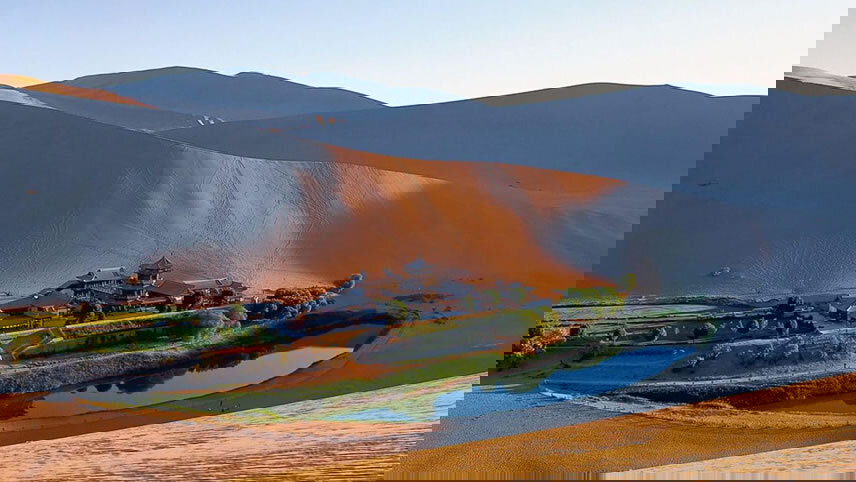
From here you will visit Crescent Lake which is a crescent-shaped lake in an oasis. Just as oil and water don't mix, so do springs and deserts. But Crescent Spring is an exception. Having been lying among these sand dunes for thousands of years, although given many surprise attacks by sandstorms, Crescent Spring still gurgles clear and remains worthy as the first spring in the desert.
Today you will drive 460km to Jiayuguan (approx. 5 hours driving time). The remainder of the day is yours at leisure.
Jiayuguan Pass, located in the southwest part of Jiayuguan City, is 6 km from downtown. This was the first pass at the west end of the Great Wall, and one of the main passes of the Great Wall. Among the passes on the Great Wall, Jiayuguan is the most intact surviving ancient military building.
This part of the Great wall was built by using local gravel and yellow earth, layer upon layer, and it consists of the main path, battlements and three observation posts. Its imposing appearance and manner are very much like those of Badaling Great Wall in Beijing, so it is reputed as ‘the Western Badaling Great Wall'.
Today you continue with a visit to Jiuquan. The city's name came from a legendary tale of the young Han general Huo Qubing, who poured a jar of precious wine into a local creek in order to share the taste with his troops, in celebration of their crushing victory against Xiongnu forces. The creek was later named Jiu Quan (“Wine Spring”), which became the name of the Han prefecture established there. It was an active military garrison during the later Han Dynasty. The area was the frontier for much of China's history, forming a natural passage to the Central Asian portion of the empire. The Mongol Emperor Kublai Khan is said to have been born in the Dafo Temple. From here you will visit the Tombs with Murals of the Wei and Jin dynasties.
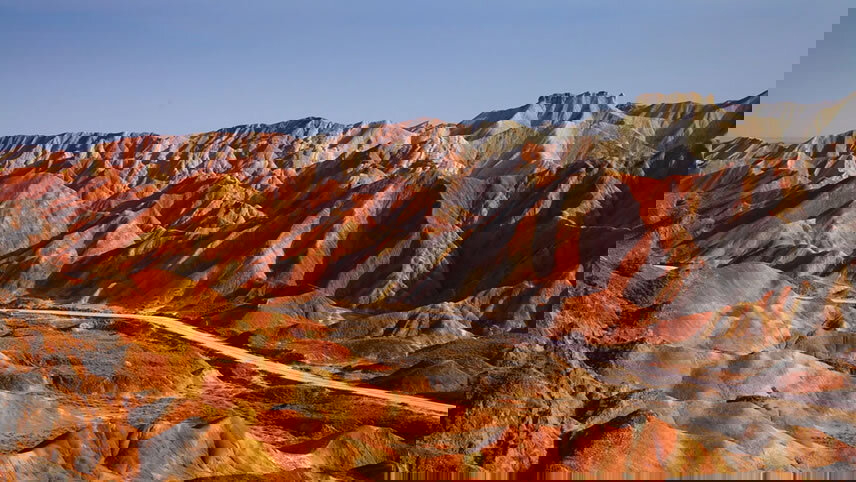
Continue your journey to Zhangye, (approx. 4 hours driving) via Gaotai and the Linze Danxia Colourful Hills. Zhangye Danxia is known for the unusual colours of the rocks, which are smooth, sharp and several hundred metres tall. They are the result of deposits of sandstone and other minerals that occurred over 24 million years. The result, similar to a layer cake, is connected to the action of the same tectonic plates responsible for creating parts of the Himalayan mountains. Wind, rain, and time then sculpted extraordinary shapes, including towers, pillars, and ravines, with varying colours, patterns, and sizes.
Visit the Giant Buddha Temple (Dafo Temple) which contains the largest reclining wooden Buddha in China and is the reputed birthplace of Kublai Khan. In the afternoon, drive to Wuwei (approx. 3.5 hours), historically the only route from central China to western China and the rest of Central Asia.
Start your day in Wuwei with a visit to Leitai Han Tomb, named as there was a temple built to honour the Chinese god Leishen on the ten-metre-high earth platform that was erected during the middle Ming Dynasty. The most important is the Bronze Galloping horse which is the symbol of China Tourism.
Visit Wenmiao, the local Confucius Temple, before driving to Lanzhou in the afternoon (approx. 5 hrs). Lanzhou is situated on the upper reaches of the Yellow River where it emerges from the mountains.
Visit the Gansu Provincial Museum in the morning. The museum has an excellent selection of exhibits relating to Gansu and the Silk Road. In the afternoon, take the sheepskin raft on the Yellow River with stops at Zhongshan Bridge and Waterwheel Exhibition Park.
Drive 150km to Linxia (approx. 5 hrs) which is home to the Hui ethnic group. For centuries, Hezhou/Linxia has been one of the main religious, cultural, and commercial centres of China's Muslim community, earning itself the nickname of “the little Mecca of China.”
Visit Linxia Dagongbei, The Great Gongbei, an Islamic shrine complex centered on a grave of a Sufi master. The grave itself is usually topped with a dome; Nanguan Mosque, one of the largest mosques in the Lingxia. Continue your journey to Xiahe this afternoon. Xiahe is home to the famed Labrang Tibetan Buddhist Monastery, one of the largest Tibetan Buddhist monasteries outside of the Tibet Autonomous Region. The town is populated largely by ethnic Tibetans, as well as some Hui and Han Chinese. The area is highly rural and pastoral where you will see yaks grazing and other pastorals animals.
Today enjoy a full day excursion to Labrang Monastery and Sangke Grassland. The Labrang Monastery is one of the six great monasteries of the Gelug school of Tibetan Buddhism. The monastery boasts tens of thousands of statues of Buddha made of gold, silver, copper, and aluminium. There are statues with ivory, sandalwood, jade, crystal and clay as the basic materials. These Buddha statues are all lifelike with kind-looking faces. In addition, the monastery possesses many Buddha hats and many Buddhist treasures adorned with pearls, jadeite, agate and diamonds.
Today you will drive back to Lanzhou (approx. 5 hours) with a visit en-route to Bingling Temple Grottoes by boat. Bingling Temple is a series of grottoes filled with Buddhist sculptures carved into the natural caves and caverns in a canyon along the Yellow River. It lies just north of where the Yellow River empties into the Liujiaxia Reservoir.
From the boat, you can see the Jishi Hill where the caves are excavated. Upon arrival in Lanzhou, you will be transferred to the train station for your high-speed train to Xi'an.
Upon arrival in Xi'an, you will be met and transferred to your hotel for breakfast. After breakfast, take a walk along the ancient city walls which is not only the most complete city walls that has survived in China, but also one of the largest ancient military defence systems in the world. You also have an opportunity to ride a bicycle (not included) around the city walls if you wish.
This afternoon, walk through the lively Muslim Quarter to visit the Grand Mosque. The 60,000 strong Muslim community that lives and works today in Xian traces its history back to Arab and Persian merchants who, after travelling the Silk Road, became permanent residents here for 13 dynasties. Enjoy watching a puppet show in the Muslim Quarter.
For dinner this evening, enjoy a dumpling banquet, where you'll taste dumplings of many different shapes, sizes and flavours.
Today enjoy the last highlight of Xian: The Terracotta Warriors'Horses where you will see the life-sized defending army to the first emperor of China, Qinshihuang. Discovered by local farmer in Lintong, it is a form of funerary art buried with the emperor in 210–209 BCE and whose purpose was to protect the emperor in his afterlife.
This evening, board an overnight train to Beijing.
Upon arrival in Beijing, you will be met and transferred to your hotel for breakfast. The day starts from the centre of Beijing – Tian'anmen Square with a walk to the Forbidden City. This was once the Chinese Imperial Palace and has a history of almost five hundred years. It is said to be the world's largest existing palace complex with 999.5 rooms. Whilst walking in the city, you can retrace the Chinese history from Ming Dynasty to the end of the Qing Dynasty.
Experience Beijing and its food in a more modest way by walking through the Hutongs, the narrow alleys in old Beijing, on a “Hutong foodie walk.” This will include traditional local dishes from other parts of China. Start at the centre of Beijing at the Bell Tower to taste Beijinger's traditional dishes before walking through the market and enjoying lunch at an authentic Uighur restaurant. Finish at Houhai Lake where you will have free time to explore.
Following the fall of the Ming Dynasty in June 1644, the era of large-scale fortification construction across China came to an end. Over the centuries, the Great Wall's once-formidable ramparts succumbed to natural erosion, human interference and neglect. Today's journey takes you approximately 5–6 hours by road, leading out of the city and into the countryside where one of the Wall's lesser-visited, unrestored sections, often referred to as the ‘Wild Wall', awaits.
Your hike today (approx. 3–4 hours) traces the crumbling remains of the Great Wall. You'll navigate uneven stonework and pass through weather-worn watchtowers, with little sign of modern interference. This section offers a raw and powerful perspective of the Wall's scale and purpose, far removed from the restored tourist zones. With the landscape reclaiming the structure, it stands as a striking reminder of both the ingenuity and impermanence of dynastic China.
This morning is yours at leisure until it is time for you to transfer to the airport for your onward flight. For those looking to extend their time, why not continue on Marco Polo's route and add on our extension to Xanadu.
Trip Inclusions
- Step on the shores of Karakuli Lake, the largest alpine lake in the world
- Village visit with a traditional Uighur dinner in a local home
- Explore the Jiaohe Ancient City renowned as the “perfect ruins of an earth building”
- Discover Mogao Grottoes containing priceless paintings, sculptures, 50,000 Buddhist scriptures, historical documents, textiles, and other relics
- Visit Crescent Lake, a crescent-shaped lake in an oasis in the middle of the desert
- Admire the Danxia coloured hills
- Travel down the Yellow River on a traditional sheep skin raft
- Enjoy a hutong foodie walk
- Trek on the unrestored Great Wall
- Return airport transfers
- 24 nights' accommodation including 2 overnight trains
- 24 Breakfasts, 22 Lunches, 2 Dinners
- Soft sleeper train from Kashar to Kuche & Xi'an to Beijing (4 person share 1 cabin, no luggage check in service)
- The 2nd class speed train from Turpan to Dunhuang & Lanzhou to Xi'an, no luggage check in service.
- Private transfers throughout and sightseeing as per the itinerary
- Transportation in an air-conditioned vehicle
- Local English-speaking guides
- Entrance fees as per the itinerary
- All currently applicable taxes
- International & domestic air tickets not mentioned above
- Meals and beverages not mentioned above
- Early check-in and late check out
- Visas
- Personal travel insurance
- Expenditure of a personal nature such as drinks, souvenirs, laundry, tipping etc
- Early check-in/Late check out
- Accommodation, itinerary and inclusions subject to change.
- Disruptions to itinerary may occur.
Dates & Pricing
Your Global Journeys Travel Advisor will check the availability of your departure date when you Enquire. Additional savings may apply. T&C’s apply.
Tour & cruises prices are per person. Prices shown have savings applied, are subject to availability and may be withdrawn at any time without notice. Pricing and trip details are correct at this point in time, however are subject to confirmation at the time of booking and are subject to change by Crooked Compass. For cruise itineraries, cabin images are sourced from the cruise-line and should be treated as indicative only. Cabin inclusions, upholsteries and room layout may differ to the image(s) shown depending on the ship selected and your sailing dates.
Similar Tours