Kimberley Coast Adventure Cruise
Overview

Best explored by expedition vessel, our luxurious, 140-guest expedition ship Heritage Adventurer was purpose-built for adventures like cruising Australia’s wild and remote Kimberley Coast. Her smaller size allows for an intimate, up-close exploration and immersion of this rugged wilderness dwarfed by nature on an unfathomable scale.
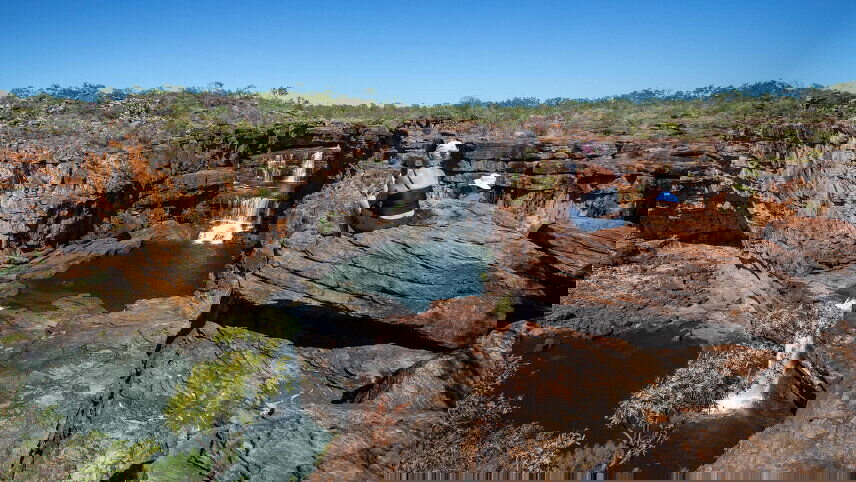
During our voyage, read more we plan to discover the unforgettable spectacle of King George Falls cascading 80-metres down 2,000-million-year-old towering cliffs. We also expect to explore the outdoor galleries showcasing the 60,000-year-old Aboriginal rock art of the Gwion Gwion and Wandjina people, World War II relics and early European explorer history.
At Talbot Bay experience the power of the region’s massive tidal movements and the world’s only Horizontal Falls, described by David Attenborough as “one of the greatest wonders of the natural world”.
Marvel at the world’s largest inshore reef system at nearby Montgomery Reef, which ‘rises’ out of the water with the falling tide. On Boongaree Island, look for Monjon (the smallest member of the rock-wallaby family), Northern Quoll, Scaly-tailed Possum and the Northern Leaf-nosed Bat as we explore stunning weather-worn landscapes, while the little-known Osborn Islands promise an authentic expedition adventure.
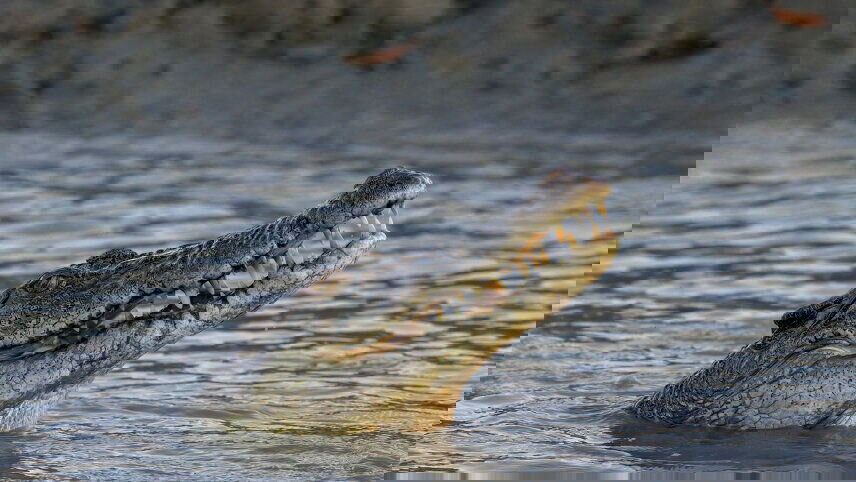
Hidden among jagged sandstone monoliths, the final resting place of the remarkably preserved WWII Douglas C-53 Skytrooper awaits discovery at Vansittart Bay. Enjoy astounding wildlife encounters and observations of the region’s iconic saltwater crocodiles and marsupials and explore one of the world’s largest and most pristine mangrove systems along the Hunter River, home to White-bellied Sea Eagles, Ospreys, Red-headed Honeyeater, Blue-spotted Mudskippers, Fiddler Crabs and more.
Discover and explore ancient landscapes like no other as we expedition cruise the untouched beauty of the Kimberley on this unforgettable adventure.


Itinerary
Join Heritage Adventurer this afternoon at Darwin Port, Australia's ‘northern gateway' famous for its glittering harbour, World War II history and enviable tropical outdoor lifestyle. The captain and expedition team will be waiting to greet you on arrival and show you to your accommodation. You will have time to settle in and familiarise yourself with the ship; we will also take the opportunity to introduce you to your expedition team and our voyage plans. You are invited to join the expedition team in the Observation Lounge and up on the Observation Deck as we set sail for King George River.
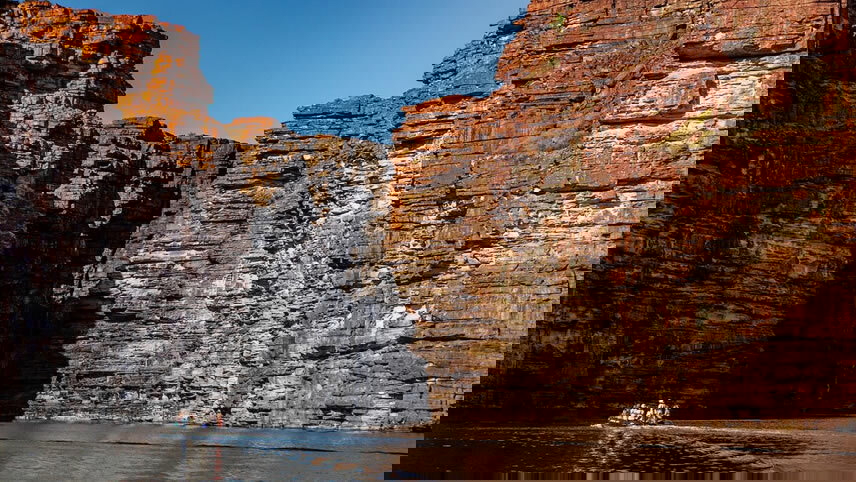
Our approach to the King George River gorge is not to be missed and best experienced out on the Observation Deck as the towering 2,000-million-year-old Warton Sandstone cliffs dwarf our vessel. Navigating this scenic stretch of water by Zodiac, there's much to take in, passing the ever-changing eroded rockfaces as we cruise deeper into the gorge, marvelling at the untouched beauty of this iconic waterway. As we reach the end of the gorge, nothing will prepare you for the grand scale spectacle of the Kimberley's highest single-drop waterfall, King George Falls.
The King George River plummets 80 metres over the edge of towering ancient red sandstone cliffs into tidal waters. This is undoubtedly one of Australia's most awe-inspiring natural wonders. The twin falls, known as male and female Rainbow Serpents, or Wunkurr by the Balanggarra people, are fed by wet season rains and rightly hold a special place in indigenous lore. While here, we will learn about how this natural wonder was created and enjoy a closer look.
Today is an authentic expedition day of adventure as we sail into Admiralty Gulf, location of the Osborn Islands. During our time here, we plan to explore the islands and discover their rich Indigenous history through ancient rock art galleries, pearl farming and look for a swimming hole to cool down in. We also plan to search for the historic 1892 wreck of steam yacht SS Sunbeam, which accidently ran aground on a mud bank while its captain raced an irreparable leak, trying to run the vessel ashore.
Today, our Kimberley expedition cruise sees us navigating the scattered islands known as the Bonaparte Archipelago, which stretches almost 150 kilometres along the dramatic coastline. Our destination is the remote and unspoiled inlet of T-shaped Swift Bay with its sandy beaches, ominous sea-worn caves and mangroves we plan to explore, including Lucifer's Labyrinth. A Zodiac cruise here allows a closer look at this incredible coastline, where we will also likely observe saltwater crocodiles. On land, several rock art galleries display the unique Wandjina and Gwion Gwion styles on a large scale, denoting the region's cultural importance.
There is also the opportunity to experience the grandeur of the iconic Mitchell Falls on a thrilling scenic heli-flight (optional extra). This is the only way to experience the Kimberley's famous four-tiered falls and includes a landing on the stunning Mitchell Plateau, one of the most scenic and biologically important areas in Australia. Here we will explore this incredible sandstone landscape carved by the Mitchell River.
This morning we explore the sites of ancient Aboriginal rock art on Bigge Island and the historic Mermaid Boab Tree, which bears the name of the HMC Mermaid. This was famously carved into its trunk while the ship was beached there undergoing emergency repairs during Philip Parker King's third voyage of discovery of the region in 1820.
Now measuring some 3 metres wide and National Heritage listed, the tree offers a glimpse into Australian colonial history, while an old Makassan Islamic prayer alcove can be found behind the tree. During our time here, we will also explore the jaw-slackening, otherworldly sandstone coastline of York Sound with its incredible sea caves and fascinating wildlife.
Located at the eastern end of the Buccaneer Archipelago, and only accessible by sea, we have two days to explore the ancient land- and seascapes of Collier Bay and its astounding natural attractions. At Talbot Bay, we will experience the power of the region's massive tidal movements which have shaped the landscape, most famously at the world's only Horizontal Falls. Here we will witness what David Attenborough described as “one of the greatest wonders of the natural world”, as water trapped in an inland bay thunders between two narrow chasms as the tide drops more than 14 metres on the other side.
This creates spectacular falls, whirlpools and boiling white water. At nearby Cyclone Creek, we will explore the twisted geological folds of the ancient seabed and hope to see the inquisitive Tawny Nurse Sharks among the incredible marine life on display. Another tidal spectacle awaits at Montgomery Reef at the bay's centre, the world's largest inshore reef system, we plan to capture the magic of observing this enormous reef ‘rise' from the ocean as the tide falls. This creates torrents and waterfalls up to 3-metres high, displacing marine life igniting a feeding frenzy as predators above and below the water descend. At Freshwater Cove, shoreline explorations of the caves and grottos reveal a multitude of ancient landscapes and rock art galleries.
During our explorations of the Hunter River today it will quickly become apparent why this winding, 30-kilometre stretch of water is widely considered to be one of the highlights of the Kimberley Coast. Tucked into the north-east corner of Prince Frederick Harbour, an enormous bay puts the Kimberley's epic scale into perspective.
This scenic wonderland is dotted with islands and flanked with wildlife-filled mangrove-lined rivers, savanna woodlands and patches of lush monsoon rainforest, courtesy of receiving the lion's share of the region's rainfall, and soaring red cliffs. At the river's mouth the unrestrained grandeur of 200-metre-high sandstone escarpment, Kampamantiya, keeps silent sentry, welcoming us into this otherworldly realm we will be exploring today. Fed by two 90-metre waterfalls, the Hunter and the Donkin, Hunter River is home to one of the largest and most pristine mangrove systems in the world.
Zodiac cruising Porosus Creek could see us spotting diverse wildlife, including White-bellied Sea Eagles, Ospreys, Great-billed Herons, Eastern Reef Egrets, Red-headed Honeyeaters, Blue-spotted Mudskippers, Fiddler Crabs and more. As well as the iconic saltwater crocodile Crocodylus Porosus, of which the Hunter River boasts the Kimberley's largest population. While here we will also explore Boongaree Island (Wunundarra or Bunjinii), home to Monjon (the smallest member of the rock-wallaby family), Northern Quoll, Scaly-tailed Possum, Northern Leaf-nosed Bat, stunning sandstone landscapes and unexplored mangrove channels.
Beautiful islands, pristine white sand beaches lapped by turquoise waters, secluded coves and stunning scenery abound in Vansittart Bay. It is also the location of a historical World War II site and incredible ancient Aboriginal rock art. Named after the Chancellor of Exchequer by early explorer Rear Admiral Philip Parker King, this striking, naturally protected bay is framed by scattered jagged sandstone monoliths. The Bay is also the final resting place of the preserved skeleton of a WWII Douglas C-53 Skytrooper (DC-3), which crash landed onto the saltpan after running out of fuel during a mercy mission to evacuate four Dutch citizens from Java.
On Jar Island, the location of ancient outdoor Aboriginal Gwion Gwion art galleries set among fascinating caves and rock formations. Much of the rock art tucked under ledges and featured on cave walls is estimated to be up to 40,000 years old. They are remarkably preserved, protected from the elements. The island is also home to some interesting flora and fauna, including the Golden-backed Tree Rat, echidnas and birdlife. Discover a bounty of anthropological and historical wonders in Vansittart Bay.
At sea en route to Darwin Port, relax and reflect on our amazing adventure. This is also a good opportunity to edit any remaining photos while they are fresh in your mind, and you have the experience of our expedition team on board for questions about the Kimberley. We will recap the highlights of our expedition and enjoy a farewell dinner tonight as we sail to our final port.
This morning sees Heritage Adventurer returning to Darwin Port. After breakfast there will be a complimentary coach to a central Darwin location or to Darwin International Airport. To allow time for disembarkation procedures and travel from Darwin, we do not recommend booking flights departing before 1300 hours. During our voyage, circumstances may make it necessary or desirable to deviate from the proposed itinerary. This can include poor weather and opportunities for making unplanned excursions. Your Expedition Leader will keep you fully informed. Please note: Voyages are planned and scheduled pending final regulatory approval.
Life On Board
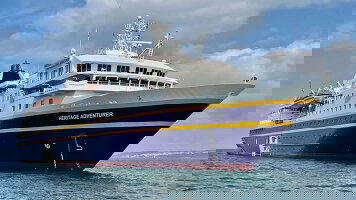
Built for polar exploration with a great track record, guests cruise in comfort onboard the Heritage Adventurer. Read more
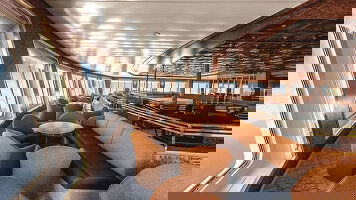
Sit back and enjoy a drink in the Observation Lounge, or experience 360-degree views from the Observation Deck. Read more
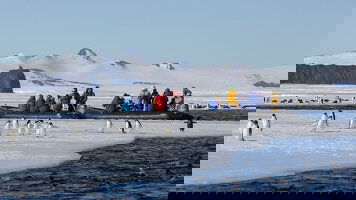
To make sure every guest has an elevated experience, Heritage Adventurer comes ready with a fleet of 14 zodiacs. Read more
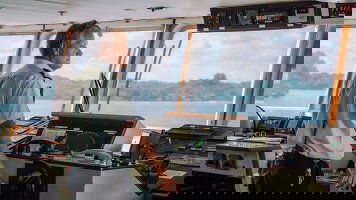
Take a look behind the scenes and see the captain at work, learn how the ship works and enjoy some of the best views onboard. Read more

Keep your fitness up during your cruise in the onboard gym or alleviate and revitalise yourself in the spa. Read more

Whether it's a quick bite to eat or a multi-course evening meal, Heritage Adventurer's all-inclusive dining will satisfy your hunger. Read more

Dates & Pricing
Cabin Layout Options:
Select Cabin Preference:
Tour & cruises prices are per person. Prices shown have savings applied, are subject to availability and may be withdrawn at any time without notice. Pricing and trip details are correct at this point in time, however are subject to confirmation at the time of booking and are subject to change by Heritage Expeditions. For cruise itineraries, cabin images are sourced from the cruise-line and should be treated as indicative only. Cabin inclusions, upholsteries and room layout may differ to the image(s) shown depending on the ship selected and your sailing dates.
Similar Cruises
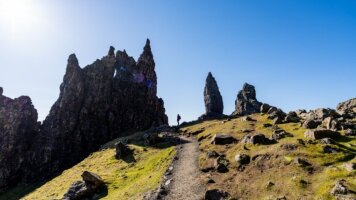
12 Days London Glasgow
Operated By: Heritage Expeditions
10 Days Osaka Osaka
Operated By: Heritage Expeditions
12 Days Lisbon Portsmouth
Operated By: Heritage Expeditions
12 Days Ushuaia Ushuaia
Operated By: Heritage Expeditions
