Overview



Itinerary
Arrive at Aberdeen International Airport and transfer to our Embarkation Suite (conditions apply below). Explore Aberdeen at your leisure before returning to our Embarkation Suite at the designated times for the group transfer to Sylvia Earle.
Important information:
- Complimentary airport arrival transfers are provided as group transfers for passengers arriving at Aberdeen International Airport prior to 12:00pm on Day 1 only.
- Passengers who arrive after the airport transfer cut-off will need to make their own way to the Embarkation Suite before 2:00 pm to complete mandatory check-in.
- For passengers already in Aberdeen, we ask you to visit our centrally located Embarkation Suite with all luggage, which will be open for mandatory check-in between 9:00 am and 2:00 pm.
- Passengers have access to our centrally located Embarkation Suite, including luggage storage, Aurora Expeditions staff for voyage and city information and cabin check-in, WIFI, tea, coffee and light refreshments.
- Embarkation Suite location: 6 months prior to departure.
- As your luggage will be transported to the ship at 2.30pm and ahead of you, please ensure you place any items you require during the day in your day bag, including passports, cash/cards and medicines.
In the late afternoon join a mandatory group transfer to board the Sylvia Earle. After boarding, there’s time to settle into your cabin before our important safety briefings before we ‘throw the lines’ to begin our Scotland adventure. This evening, join your fellow travellers for an onboard Welcome Dinner, where your expedition team will introduce you to the expedition ahead and raise a toast to the adventures to come.
Kirkwall, the capital of Orkney, rewards exploration beyond its modern harbour. Narrow lanes wind through the historic centre, while the surrounding West Mainland blends fertile farmland, rolling hills, moorland and dramatic Atlantic cliffs. Depending on your chosen excursion, discover some of Orkney’s great archaeological treasures.
Personalise your expedition with an included ‘Your Choice’ experience suited to your interests and fitness level.
Option 1: Orkney Treasures – Skara Brae
Duration: 4 hours
Level of difficulty: Moderately paced
Travel through Orkney’s tranquil countryside into the UNESCO World Heritage-listed Heart of Neolithic Orkney. Pass the Standing Stones of Stenness and pause at the Ring of Brodgar, an immense ceremonial stone circle created almost 5,000 years ago. Continue to Skara Brae, where a remarkably preserved Neolithic village lay hidden beneath sand dunes until storms revealed it in the 19th century. Explore the visitor centre and ancient stone dwellings before walking approximately 200 metres to Skaill House. Built in 1620 on a site with Norse origins, this elegant manor has been home to 12 generations of the same family and contains a fascinating collection spanning four centuries.
Option 2: The Heart of Neolithic Orkney
Duration: 3.45 hours
Level of difficulty: Moderately paced
Journey into Orkney’s UNESCO World Heritage-listed Neolithic heartland. At the Ring of Brodgar, contemplate a vast ceremonial stone circle created almost 5,000 years ago, then visit the taller and even older Standing Stones of Stenness. Walk to the nearby settlement of Barnhouse and discover how its Neolithic inhabitants may have lived. Pause at a bird hide overlooking peaceful Harray Loch before returning to Kirkwall to visit St Magnus Cathedral, an enduring expression of Orkney’s Norse heritage. Together, these sites offer a fascinating view of the communities, beliefs and mysteries that have shaped the islands.
Almost 160 kilometres (99 miles) north of mainland Scotland, the Shetland Islands sit at a similar latitude to Bergen and the southern tip of Greenland. Summer brings extraordinarily long days to this archipelago of around 100 islands, rich in nature reserves, archaeological treasures and distinctive island traditions. Depending on conditions, we hope to explore several of the following places:
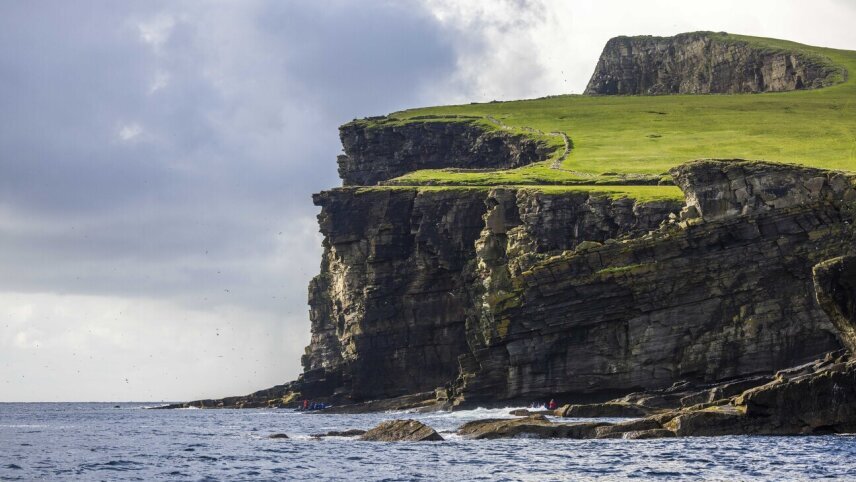
Between Orkney and Shetland, tiny Fair Isle is renowned for its bird observatory, distinctive knitwear and dramatic shipwreck history. Cliffs surround much of the island, while its small community lives mainly in traditional crofts across the more fertile south.
Positioned beneath major migration routes from Scandinavia, Iceland and the Faroe Islands, Fair Isle is a paradise for birdwatchers. In summer, fulmars, kittiwakes, guillemots, gannets, shags and puffins crowd the cliffs. Wildflowers flourish across the island, and we may meet local residents, hike through the landscape or visit the museum. The surrounding waters are home to grey and common seals, with possible sightings of porpoises, dolphins, orcas and minke whales.
From Lerwick, we plan to discover Jarlshof, one of Shetland’s most complex archaeological sites. Revealed by storms in the late 19th century, the site preserves evidence of more than 4,000 years of settlement, from Neolithic homes and a Bronze Age smithy to Iron Age buildings, Norse longhouses and a medieval farmstead. The name ‘Jarlshof’ was bestowed by Sir Walter Scott in his novel The Pirate.
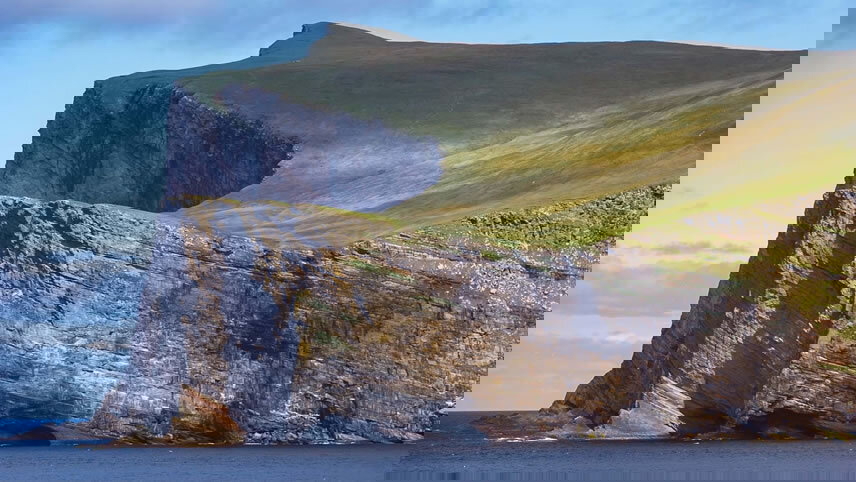
Noss National Nature Reserve is famed for its kilometre-long seabird cliffs. During breeding season, the calls of around 150,000 birds and chicks fill the air as gannets, guillemots and other seabirds occupy ledges in sandstone cliffs rising almost 200 metres (656 feet). Seals rest along the shoreline, while otters sometimes forage among the kelp.
On the uninhabited island of Mousa stands Mousa Broch, the best preserved of Scotland’s Iron Age fortified towers. Nearly 2,000 years old, its remarkable stonework still rises more than 13 metres. By day, common and grey seals may be seen along the shore, and we will keep watch for otters—known locally as dratsies.
Across Orkney’s 70 windswept islands, layers of human history unfold—from 5,000-year-old Neolithic monuments and Norse heritage to wartime remains and present-day crofting communities. Seabirds crowd the imposing sea cliffs, coastal paths beckon hikers and, when conditions allow, kayakers can discover sections of the archipelago from the water.
On Papa Westray, we plan to visit the Knap of Howar, where Northern Europe’s oldest known stone houses were occupied by Neolithic farmers more than 5,000 years ago. Later, experience the warmth of island hospitality at the local pub, where the Papa Westray folk ensemble Poor Man’s Corner may fill the room with lively tunes and irresistible rhythms.
We continue to the Outer Hebrides, also known as the Western Isles, a 209-kilometre (128-mile) chain facing the open Atlantic. On the Isle of Lewis, we plan to visit the remarkable Callanish Standing Stones, raised around 3,000 BCE and set within a landscape rich in prehistoric history.
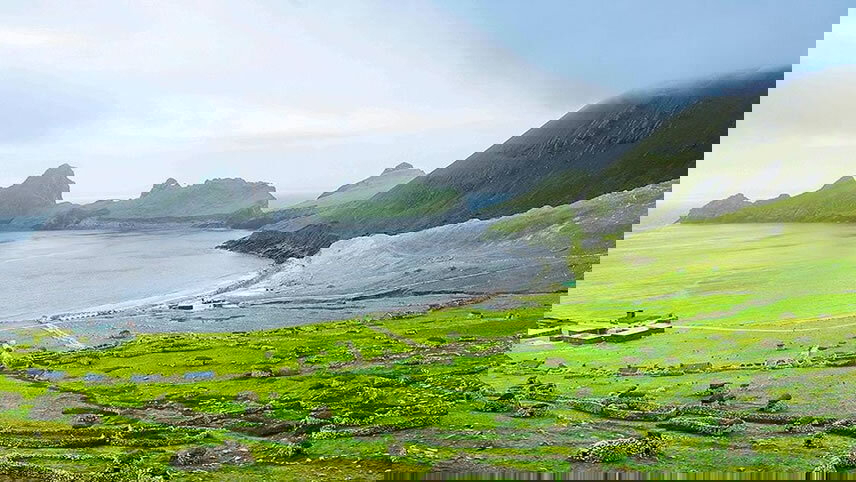
Weather permitting, we hope to land at the remote archipelago of St Kilda, recognised by UNESCO for both its natural and cultural significance. Abandoned stone homes tell of the resilient islanders who once raised Soay sheep and harvested seabirds, while immense cliffs and sea stacks support one of Europe’s most important seabird colonies.
Golden beaches, jagged peaks, heather-clad hills and remote island communities make every day in the Inner Hebrides wonderfully different. We may cruise into secluded lochs, walk among extraordinary rock formations and watch for whales, dolphins, otters, seals and basking sharks. Conditions permitting, we may also visit an island reserve where red deer and white-tailed eagles thrive.
We plan to land on the community-owned Isle of Eigg, south of the Isle of Skye. Follow scenic trails through wildflower-rich landscapes while our Expedition Team reveals the island’s wildlife, history and remarkable geology.
The Cuillin mountains on Skye form one of Britain’s most dramatic landscapes. Weather permitting, we may land at Loch Scavaig and walk towards Loch Coruisk for magnificent views of the jagged Black Cuillin and rounded Red Cuillin peaks. More experienced hikers may venture farther, while kayakers could explore the sheltered lochs or paddle towards Soay and the remains of a former shark-fishing station.
On Staffa, we hope to explore Fingal’s Cave, where waves echo between towering basalt columns. The extraordinary acoustics and geology inspired Mendelssohn’s Hebrides Overture. Depending on conditions, we may approach by Zodiac or land and walk towards the cave entrance. In season, puffins add another memorable dimension to our visit.
Later, we aim to visit the tiny island of Iona, just five kilometres (three miles) long yet central to Scotland’s spiritual history. In 563 CE, the Irish monk St Columba arrived with 12 followers and established a monastery that became an influential centre of Christianity. Iona is also the burial place of early Scottish kings and remains an important place of pilgrimage.
On arrival in Troon, disembark in the early morning and farewell your fellow travellers and Expedition Team before transferring to Glasgow Airport for your onward journey.
Note: At the conclusion of the voyage, we recommend booking flights departing after 12.00 pm on the day of disembarkation in case there are delays.
Trip Inclusions
- Meet the community of Papa Westray and enjoy spirited Scottish folk music in the convivial setting of the local pub.
- Uncover thousands of years of human history at Jarlshof, one of the British Isles’ most remarkable archaeological sites.
- Visit Iona Abbey on one of Scotland’s oldest and most sacred Christian pilgrimage sites.
- Stand beneath Britain’s highest sea cliffs at the dual UNESCO World Heritage-listed archipelago of St Kilda.
- Explore the wildlife-rich Isle of Eigg, watching for eagles, divers, stonechats, seals, dolphins and porpoises.
- Zodiac cruise beneath wild cliffs and striking sea stacks, and into wave-sculpted caves when conditions allow.
- Hike across remote, rugged islands where dramatic landscapes and far-reaching views reward every step.
- Group transfer from the airport to Embarkation Suite and to Sylvia Earle on Day 1 – conditions apply
- Group departure transfer ship to airport or city centre location on Day 11
- Onboard accommodation during the voyage, including daily cabin service.
- All meals, snacks, tea, coffee, soft drinks and juices during the voyage.
- Premium spirits, cocktails, beer, wine and liqueurs during voyage.
- Captain’s Farewell Reception, including a four-course dinner, house cocktails, house beer and wine, and non-alcoholic beverages.
- All shore excursions and Zodiac cruises.
- Educational lectures and guiding services provided by the Expedition Team.
- Complimentary access to the onboard expedition doctor and medical clinic for an initial consultation.
- A 3-in-1 waterproof polar expedition jacket.
- Complimentary use of muck boots during the voyage.
- Comprehensive pre-departure information.
- Port surcharges, permits and landing fees.
- Gratuities for local guides and drivers, and at venues and local sites, during included excursions and enrichment activities.
- Wi-Fi*.
*Please note that we travel to remote regions, where connectivity can be unreliable.
- International or domestic flights, unless specified in the itinerary.
- Transfers, unless specified in the itinerary.
- Airport arrival or departure taxes.
- Passport, visa, reciprocity and vaccination fees and charges.
- Travel insurance and emergency evacuation charges.
- Hotel accommodation and meals, unless specified in the itinerary.
- Optional excursions and optional activity surcharges.
- All items of a personal nature, including but not limited to on board gratuities*, laundry services, personal clothing, medical expenses, email or phone charges.
*A gratuity of USD $20 per person, per day for the crew and Expedition Team will be automatically added to your onboard account. You may remove or adjust this amount when settling your account. For suite guests, this gratuity is included as part of the Suite Benefits.
- Itinerary and inclusions subject to change.
Life On Board
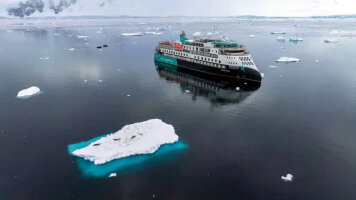
A floating ambassador for the conservation of the planet, the Sylvia Earle pays tribute to marine biologist, oceanographer and explorer Dr. Sylvia Earle and six pioneering women in conservation with public decks honouring their contributions. Read more
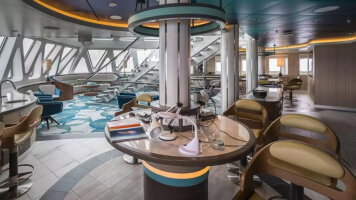
Learn more about the world and the unique destinations Aurora visits by visiting the onboard naturalist and Expedition Team in the world-class Citizen Science Center. You will be rewarded for your thirst for knowledge with one of the best views on the ship.
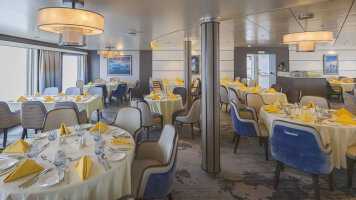
Whatever adventures the day holds, you will be fuelled-up with hearty meals and delicious morning and afternoon teas cooked by our onboard chefs. Our chefs offer a variety of menu options for each meal. Enjoy the range of house wine, beers, and soft drinks included with dinner after a long day in the wild.
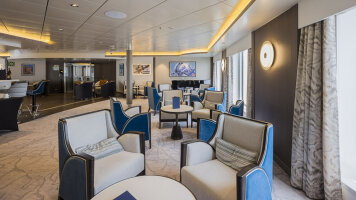
With floor-to-ceiling windows, the library is a peaceful sanctuary and wildlife guides, books and binoculars can be found in the observation lounge on Deck 7 - the perfect place to relax and watch the incredible landscapes pass by, or spot unique polar wildlife.
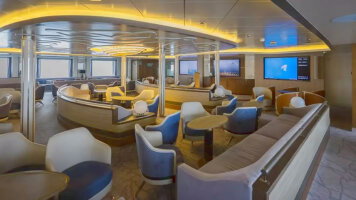
On all expeditions you will meet naturalists and local specialists, who offer presentations on their area of expertise to enhance your appreciation of the destination you are exploring.
Dates & Pricing
 AUD
AUD
Aurora Loyalty Program
GJ Loyalty Discount
Cabin Layout Options:
Select Cabin Preference:
Tour & cruises prices are per person. Prices shown have savings applied, are subject to availability and may be withdrawn at any time without notice. Pricing and trip details are correct at this point in time, however are subject to confirmation at the time of booking and are subject to change by Aurora Expeditions. For cruise itineraries, cabin images are sourced from the cruise-line and should be treated as indicative only. Cabin inclusions, upholsteries and room layout may differ to the image(s) shown depending on the ship selected and your sailing dates.
Similar Cruises
11 Days Ushuaia Punta Arenas
Operated By: Aurora Expeditions
11 Days Tromso Oslo
Operated By: Aurora Expeditions
10 Days Panama City San Jose
Operated By: Aurora Expeditions
12 Days San Jose Panama City
Operated By: Aurora Expeditions
